A University of Chicago education is about more than gaining a set of skills, achieving a rite of passage, or even honing the ability to think critically. It is a way of experiencing and moving through the world—interest in a lifelong dialogue across cultures and disciplines, inclination to ask good questions, and willingness to change perspective after encountering new ideas. From the beginning, we’ve believed in the benefits of a liberal arts education, including a robust intellectual foundation in a diversity of disciplines.
The Core
At the University of Chicago, our Core curriculum is each student’s introduction to the tools of inquiry used in every discipline—humanities, social sciences, and natural and mathematical sciences.
The Core is known for its small, Socratic-style classes capped at a maximum of 19 students where learning takes place through discussion based primary texts. The Core curriculum accounts for the first third of a student's time in the College, giving them a great deal of flexibility in how they complete it. Not everyone takes the same classes, but everyone studies similar disciplines and tackles similar intellectual challenges, which provides each student in the College a common vocabulary of ideas and common skills of analysis and argumentation. It provides a shared, unifying experience for all students in the College, as well as background for any major and habits of mind that last a lifetime.
Learn more on the College's Core website.
Majors, minors, and other programs
Complementing the breadth of the Core curriculum are more than 50 majors and 50 minors, as well as dozens of areas of specialized study, with full-time academic advisers helping students navigate these opportunities from day one.
At a liberal arts institution such as the University of Chicago, your major does not necessarily determine your career path. While for some students, choosing a major serves as a path to a specific career or profession, for others it represents a way to build skills that could apply to many different careers or to dig into a passionate academic interest. You can begin a major at any time, including your first quarter. Unless otherwise specified by the department, the deadline for declaring a major is Spring Quarter of your third year. Most students will change majors at least once during their time on campus.
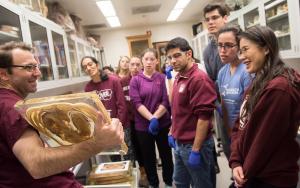
Typically, about a third of a student's courses are electives. Some students use these courses as a chance to explore a variety of personal or academic interests. About a quarter will choose to use this flexibility to double major, and about half will use it to add a minor. The deadline to declare a minor is the end of Spring Quarter of your third year.
Robust pre-professional preparation is offered though our co-curricular UChicago Careers In programs, and a number of joint BA/MA programs are open to students in the College.
The quarter system
All this exciting academic activity at UChicago takes place in a calendar of academic quarters, which last nine weeks each and conclude with a reading period followed by a week for finals. Most students take classes during Autumn, Winter, and Spring Quarters, though courses are also available during Summer Session.